What Did Stroyer Not Know About His Family Tree? How Do You Think That Made Him Feel?

Man_Half-tube/Getty Images

Man_Half-tube/Getty Images
"Well hello there Nabil!
"I welcome your letter.
...
"So in the picayune bit of data yous shared with me, I am intrigued.
"I have worked for a number of years, 26 in fact, on my genealogy. Information technology has been a passion and at times an obsession."
In her initial email to me, Karen surprised me with her excitement and candor — neither of which I was expecting from the adult female whom I had gently accused of being the descendant of the man who owned my ancestors.
"Some of my Ayers ancestors were slave owners. I am aware of this, but know that at to the lowest degree some were included equally family and are cached with my ancestors. I hope that was the case ever."
Afterwards two email exchanges with Karen, I had created a mental image of her. She was older, but not old, possibly in her 60s, with short, cropped, graying brown hair. I imagined her seated at a kitchen table every bit she typed, in a modest, cozy abode somewhere in the South:
"Yes I'm certain we are non blood-related, merely it's evident of Ayers connexion i style or some other.
...
"I just looked you up on Facebook and plant you lot! You have olive-similar complexion and wait part white. I don't hateful annihilation negative. Just my observation. Some slaves assumed or took their owners name (don't like this) but for the sake of my endeavor to explain... So allow's say this Dr. Ayers perhaps was white and he had a child with one of the slaves?"
I've never been a father, and I've never had a father. Though my dad and I live in the same city, our paths take never crossed. Occasionally, someone asks me how he's doing. It surprises me every time, and I usually reply with something like, "You lot'd probably know amend than I would," which feels confrontational and often leads to a slightly atoning, less biting explanation of the fact that I've never known him.
I hope I inherited his best qualities and missed out on his worst, simply I can merely guess what those qualities are. For much of my life, even my racial identity has been somewhat of a question.

Nabil Ayers' mother chose to have him and raise him on her own. Courtesy of Nabil Ayers hide caption
toggle explanation
Courtesy of Nabil Ayers

Nabil Ayers' mother chose to have him and raise him on her own.
Courtesy of Nabil Ayers
My mother, who is white, chose to accept me and raise me on her own. My father is black, but because he has never been part of my life, I've never held a strong black identity or felt I belonged to any single race. I grew up in very diverse and liberal surroundings where, if anyone asked, I was racially mixed, and that was fine.
I'1000 often asked the question, "What are y'all?" Or the less invasive, only still pointed, "Where are yous from?" I've always described myself every bit "half black and half white." It's a phrase I still employ for simplicity.
Simply last winter, on a clear dank twenty-four hours, I got tired of having to approximate everything. And so, like many people I know, I sent $99 and a tiny tube of my saliva to the genetic testing company 23andMe. I didn't wait any major surprises. My female parent is fairly certain of her background — Eastern European Jewish. But I was hoping to learn something — anything — well-nigh the side of my family I had never known.
A month later, I got an e-mail full of pie charts and graphics neatly breaking down my identity. According to 23andMe, I'one thousand 66.two percent European, which includes 51 percent Ashkenazi Jewish, and 32.6 percent sub-Saharan African. These numbers didn't alter who I had always been, simply they suggested that my begetter's ancestry might be less straightforward than I thought. Later seeing them, I felt less black than ever.
I'd opted in to 23andMe's communication system, which allows newly constitute DNA relatives to establish contact within the site. Before I'd had a risk to explore it, a distant cousin on my father's side contacted me. We exchanged contact information, and a couple of weeks later, I awoke to an electronic mail from him with an attachment titled Ayers Family Tree.
Instead of going into work that morning, I fabricated a pot of coffee and stayed on the couch, scrolling through the document'due south xx-plus pages of photographs and dense text. I saw dozens of names — Winnie, Luvenia, Moses — only none that I recognized.
And then I saw Ruby, my male parent's mother'southward name. Below Cerise, my father and his iii sisters. Below my father, his oldest son — his but child when the family tree was written in 1963.
I had spent my entire life knowing nearly nothing about my male parent's family. Now, I had 4 generations of our history in a unmarried email.

Nabil Ayers, shown with his maternal smashing-grandfather, writes, "As I go older, I can encounter pieces of my mother's family in myself." Courtesy of Nabil Ayers hide caption
toggle explanation
Courtesy of Nabil Ayers
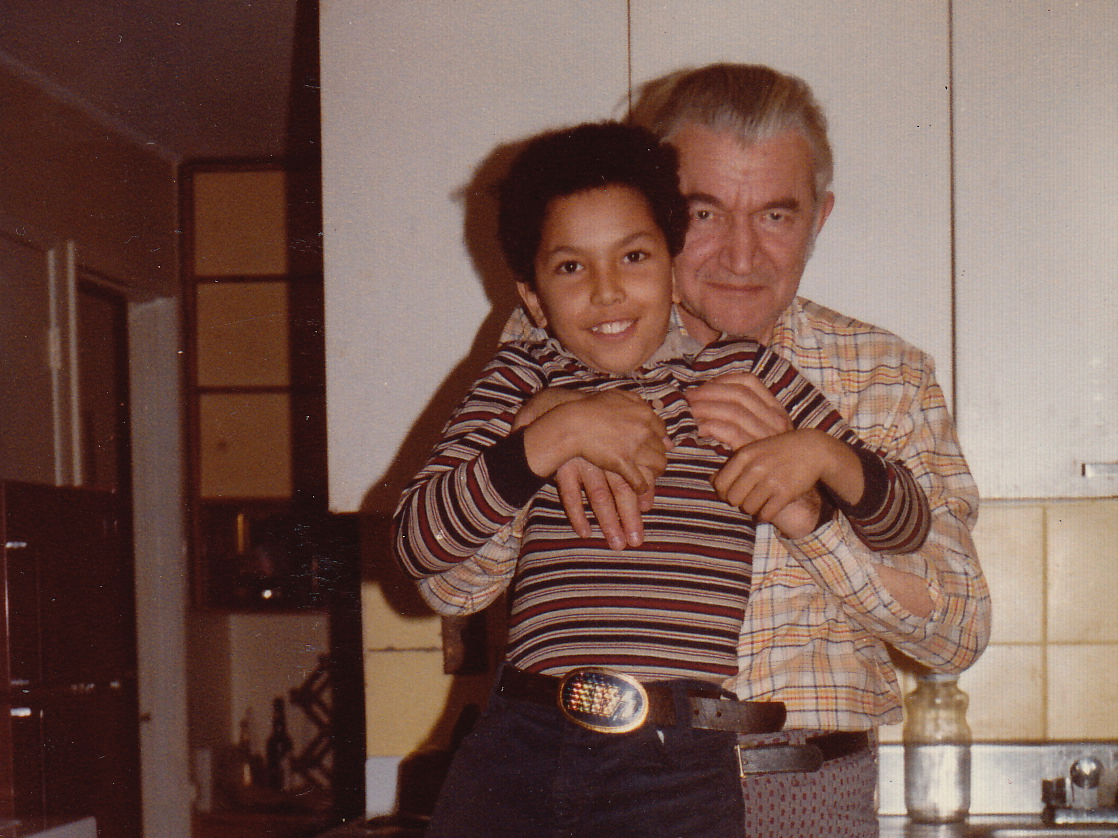
Nabil Ayers, shown with his maternal great-grandfather, writes, "As I get older, I can see pieces of my female parent's family in myself."
Courtesy of Nabil Ayers
I feel lucky to have known my mother's parents and grandad. As a child, I discovered that my female parent laughs with her whole torso, just like her grandfather, and that, similar her mother, she waves her manus as if to physically push abroad uncomfortable conversation. Equally I become older, I tin see pieces of my mother's family in myself.
But with this family tree, for the first time, I felt connected to my paternal ancestors. I read their stories and studied their photographs, searching for features in common with my ain.
Isaac Ayers, my great-great-nifty-granddaddy, was born into slavery around 1825. His son, James William Ayers, was born in 1850 and worked on a plantation for the showtime xx years of his life. Though technically free after the Emancipation Annunciation was signed in 1863, his family had no money and nowhere to become. And so, like many freed slaves, they connected to work on the plantation for another seven years.
My peachy-bang-up aunt, Jenny Elizabeth Ayers, had ankle scars from being chased by the bloodhounds used to catch runaway slaves. She had fifteen children. My aunt, Thomasina Ayers Pleasant, a strong-looking woman with a sharp smile and a striking head of reddish-black hair, earned her undergraduate and graduate degrees from USC and passed abroad just 2 years agone.
Merely 3 generations exist betwixt James William Ayers and me. My male parent's father's begetter'south father was, 155 years ago, owned past another homo being. Learning this history meant that, for the start time in my life, I felt directly connected to black ancestors who had names, faces and stories.
Suddenly, I felt less white than ever.
Just I notwithstanding wondered virtually my "66 per centum European" DNA. There's no way all of that could take come from my mom'south side of the family unit. So when I read the name of the man who had enslaved my family, Dr. Ayers (no first name given), I assumed he and I were continued — maybe fifty-fifty related. (Afterwards all, there's a long history of slave owners assaulting and impregnating their slaves. It's i of the reasons many black folks in the United States have significant European ancestry.)
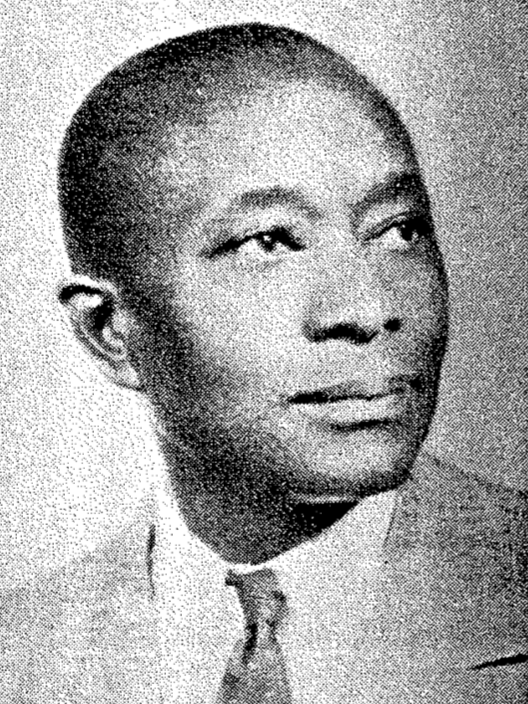
Samuel L. Ayers, author of the Ayers Family Tree, wrote: "Now every bit the evening shadows assemble around u.s.a., may there be only enough clouds to brand a beautiful, emblazoned sunset." Courtesy of Nabil Ayers hide caption
toggle caption
Courtesy of Nabil Ayers
Samuel L. Ayers, author of the Ayers Family Tree, wrote: "Now as the evening shadows gather around united states, may in that location be just enough clouds to make a beautiful, emblazoned sunset."
Courtesy of Nabil Ayers
The Ayers Family Tree claims that he endemic a plantation in Ashland, Benton County, Miss., which had a population of merely 174 people in 1880, the beginning census on record. According to the 1891 book, Biographical and Historical Memoirs of Mississippi Vol. 1, Dr. Augustus Machen Ayres was born in 1821 and buried in Ashland Cemetery in 1890. There was no guarantee that this was the man I was looking for, just he was a doctor, with the correct last name, the right historic period, in a town of fewer than 200 people. Augustus felt like a lucifer.
As I dug into Augustus' story, I came beyond a adult female who shared our terminal name and appeared to be a living descendant of his. Karen Ayers Weir. I felt an urgent need to contact her, but non for revenge or reparations. I craved noesis — a deeper explanation of who I am and how I got here.
After several minutes of overthinking, I rattled off an email to Karen:
"I hold no ill will and I am non afterwards annihilation at all. That was a different time and our family unit has since prospered. I am a happy, successful homeowner in Brooklyn, NY with a great job. I am simply fascinated past this process and I want to learn more than about the people related to my family — fifty-fifty if they were our owners."
I woke up the next morning to her response. Karen, it turned out, lived in Texas with her husband of 44 years. They had several grandchildren. She loved the outdoors and sent me photos she'd taken of birds and ships on a recent coastal trip. Piles of genealogical documents existed in her home, some of which she said might be of interest to me.
Over days and weeks, our correspondence continued, and nosotros quickly established a rapport. Here'southward one from Karen:
"Hello yourself. Yesterday was a very busy day. We ran about town all day and were completely worn out. We fabricated healthy homemade pizza. My one-half ever has black olives, red onion, feta and mushrooms- my married man's side is less veggies and more meat. Sparse crust. We watched a movie and that was the entire day.
"The rest of the calendar week is going to be crazy. I did have time to find the general area of what are sure to be my packed boxes of genealogy ..."
I began to feel equally if Karen and I were living in parallel universes. Whether or not we shared a bloodline, our ancestors had lived together in a tiny town, leading very different, merely very continued lives. And in the strange way of the globe, Karen felt similar someone who could fill up in some gaps in my history that had been left open in my father'south absenteeism. She had more of my father's history in taped-up boxes than I had gotten in my entire life.
And notwithstanding, I felt like our different circumstances might be too much to bridge. She was the descendant of slave of owners, and I, the descendant of slaves. A modest bitterness inside me wanted Karen to make a wrong move — to expose herself equally a racist or a Confederate. To allow me to experience some anger or resentment for what her family unit had done to mine.
So, later on a couple of weeks, I sent Karen some essays I had published about my racial identity and discovering the strange and powerful Ku Klux Klan history in Dallas. I was testing the waters. We were fine discussing pizza and ancient family history, only what if I introduced the subject field of racial injustice within our lifetime?
This woman was unflappable.
"Wow the article well-nigh the land fair and the klan was astounding-
"Amazing. I shared it with one of our sons who idea the same. Thanks."
And so, our unorthodox friendship connected.
My male parent volition never be a office of my life — I've known that since I was a child. I've had only a handful of conversations with him, but at present I talk to the adult female whose family owned mine several times a calendar week. It's one of the baroque accidents of the modernistic age that it's easier for me to communicate with a distant connection in Texas than with the person with whom I share half of my DNA — a person who lives in the same city as me.
When people ask, I still say I'm half black and half white for simplicity, though all this new data means that I volition never retrieve of my identity and then just again. I'll ever wonder about the relatives I never knew, whose stories I never heard. And I'll always wonder what exactly it meant for my ancestors to exist enslaved past the Ayers family — but how interwoven our identities might exist.
In that location are clouds in my family's history, some obvious and others unknown. Merely the author of my family tree, Samuel Ayers, wrote closing words that offer a glimpse into the optimism that runs through my paternal family unit. Despite stories of enslavement, deceased infants and poverty, my family tree focuses on the progress my ancestors made over a century-and-a-half: "Now every bit the evening shadows gather around us, may there be simply enough clouds to make a beautiful, emblazoned sunset."
Nabil Ayers is a Brooklyn based writer and U.S. head of the record label 4AD. You tin can observe him on Twitter @nabilayers .
Source: https://www.npr.org/sections/codeswitch/2018/11/21/413191794/a-family-tree-with-roots-deep-in-slavery

Post a Comment for "What Did Stroyer Not Know About His Family Tree? How Do You Think That Made Him Feel?"